UML overview
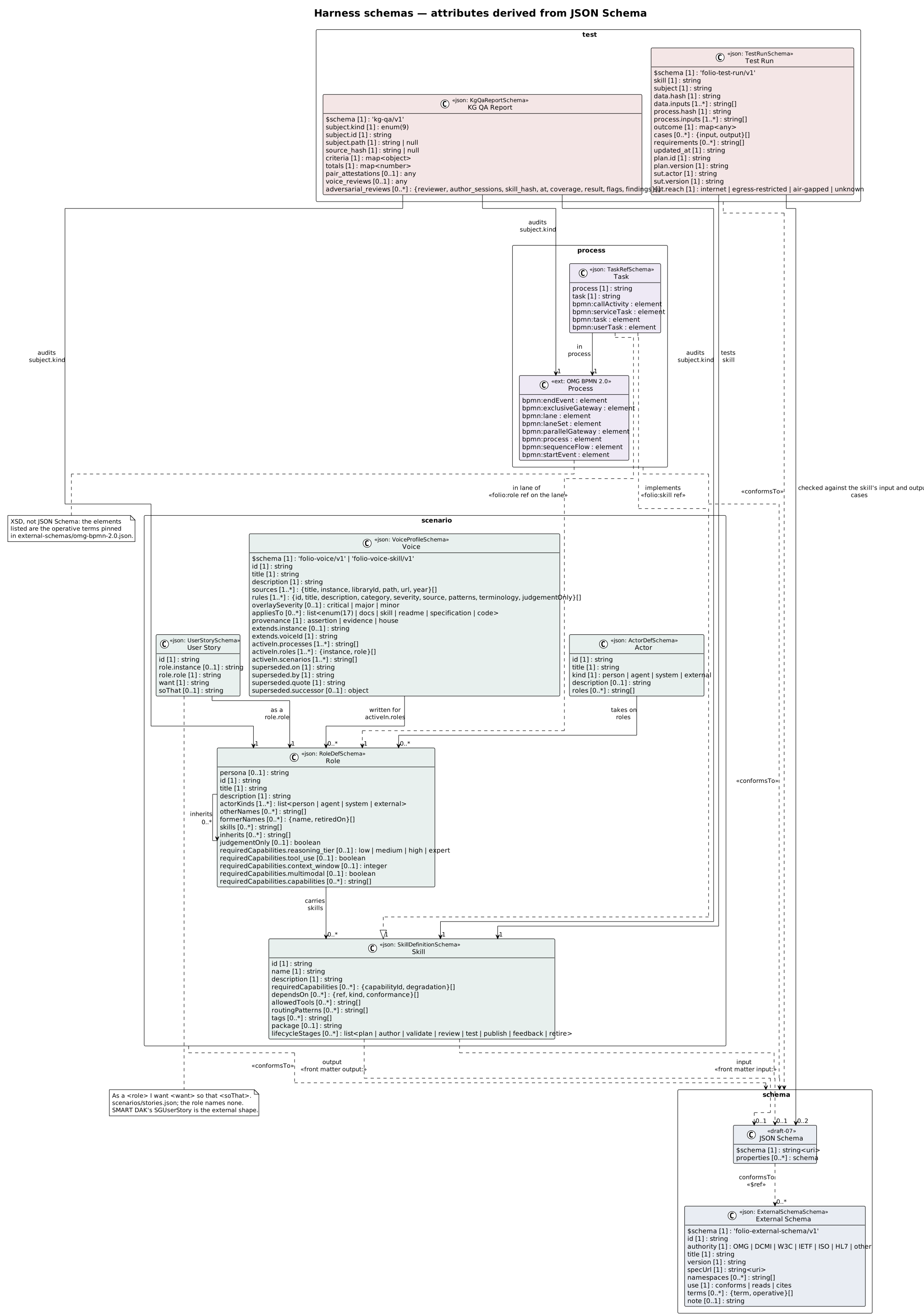
The harness schemas
Schema, Role, Actor, Skill, Voice, User Story, Process, Task and Test, each box read from the schema behind it; the stereotype names which. Colours are the five families in uml.css. Every arrow runs from the dependent to the general node: a Task realises the Skill it implements, a Voice and a User Story point at their Role, and a Test Run is checked against its Skill’s input and output schemas.
Definitions: Actor · Role · Skill · Voice · User Story · Process · Task · JSON Schema · External Schema · Test Run · KG QA Report
Source: PlantUML · the full model, with Bean and Todo, is below.
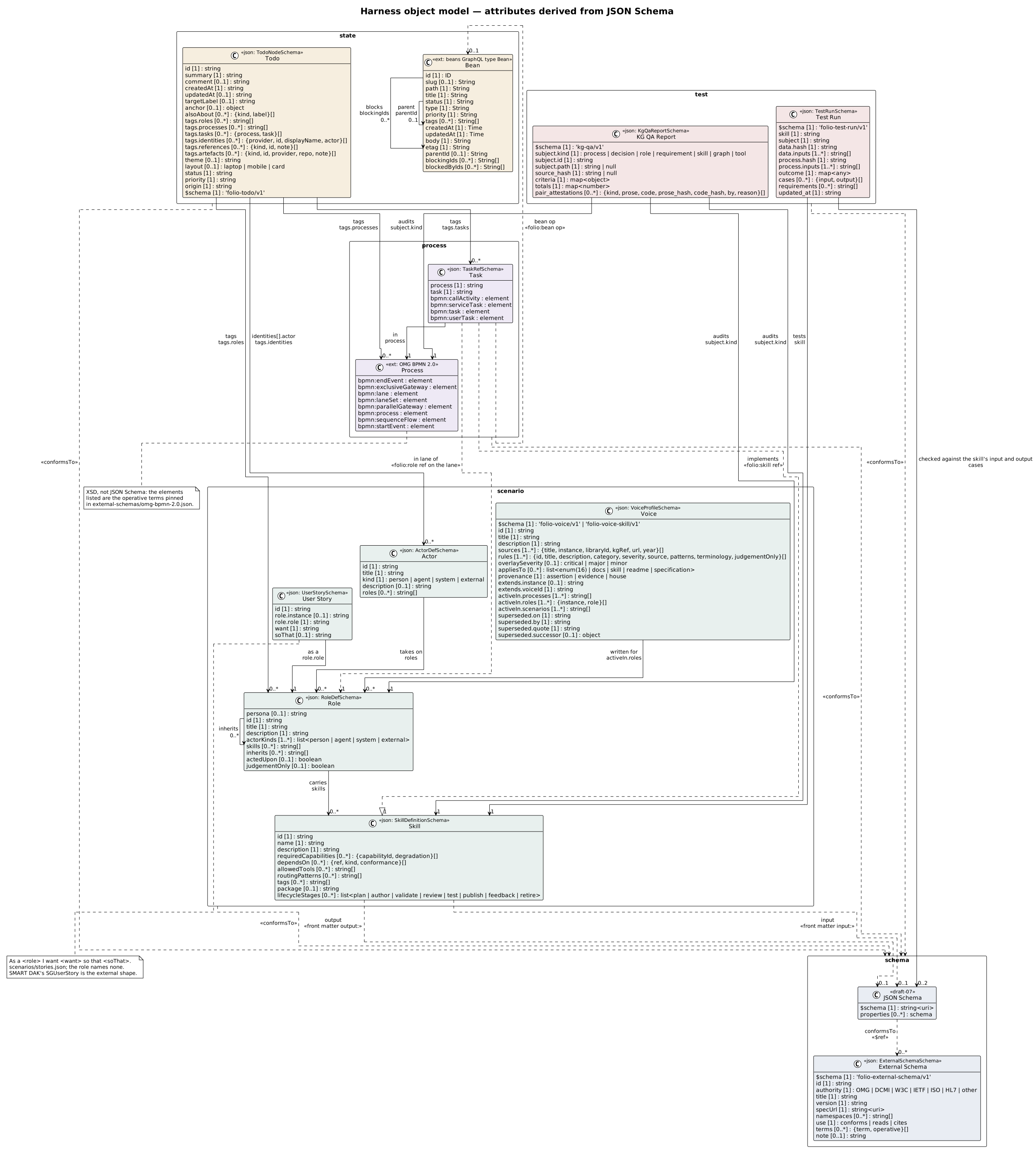
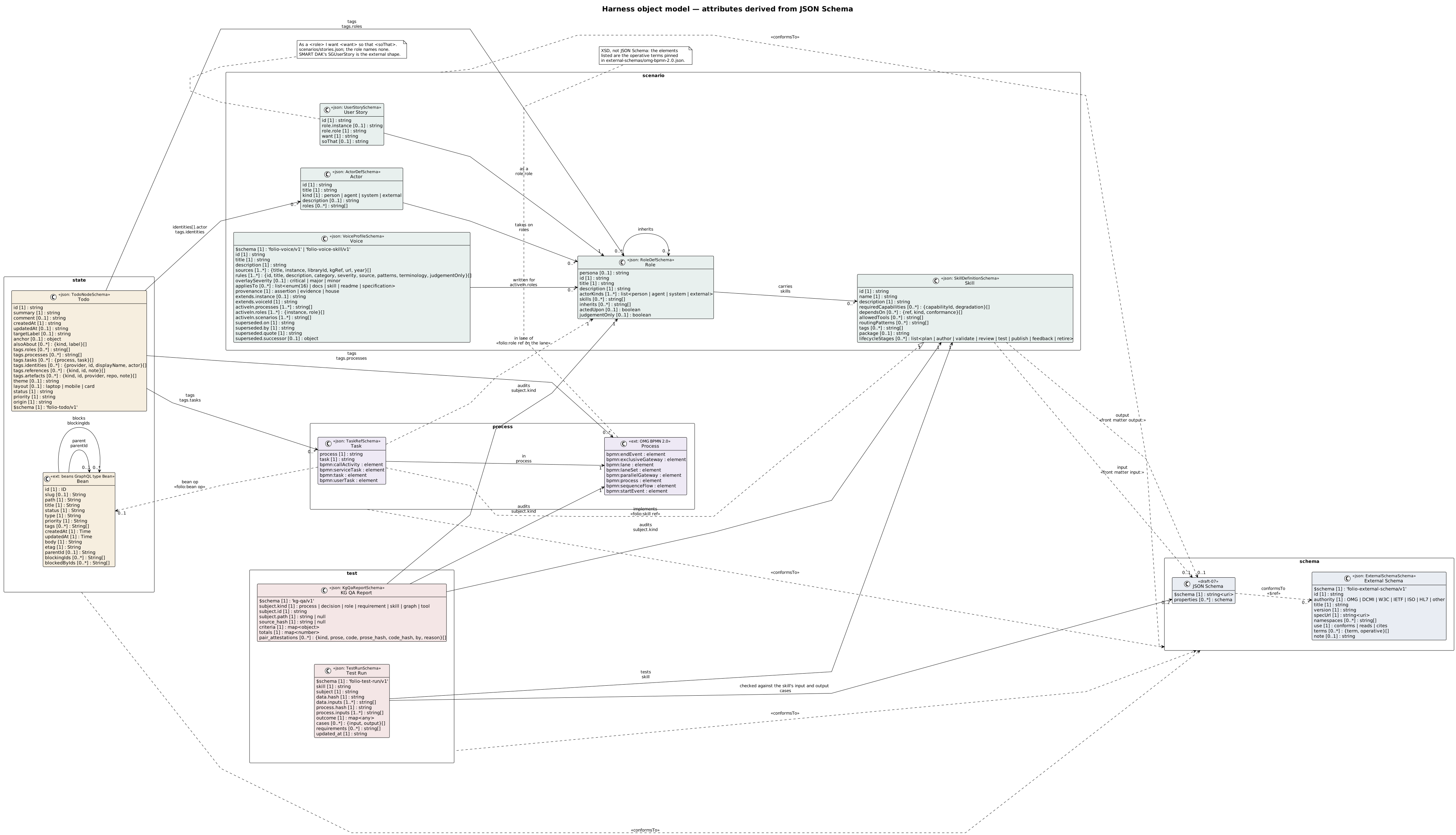
The full object model
The same classes plus the state family, Todo and Bean, and the edges that reach them: Task’s folio:bean op, and Todo’s tags on Role, Process, Task and Actor. Bean is read from the beans CLI’s GraphQL schema, so this file is regenerated only where that CLI is installed (bun run cat-harness-tools/scripts/gen-object-model-uml.ts).
Source: PlantUML
Per harness
Generated by cat-harness-tools/scripts/gen-uml-overview.ts — do not edit. One diagram per harness and one per named sub-graph it declares. Classes are read from each graph typology’s node schema; colours come from docs/assets/css/uml.css.
- bootstrap — 5 sub-graph(s)
- bootstrap-tools — 5 sub-graph(s)
- cat-harness — 79 sub-graph(s)
- cat-harness-tools — 19 sub-graph(s)
- fhir-harness — 12 sub-graph(s)
- folio-assistant-core — 31 sub-graph(s)
- folio-assistant-sci — 26 sub-graph(s)
- smart-base — 30 sub-graph(s)
- smart-immunizations — 4 sub-graph(s)
- smart-trust — 5 sub-graph(s)
- who-iris — 17 sub-graph(s)